Executive Summary
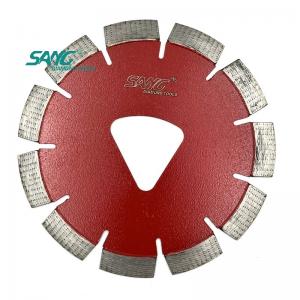
Reinforced concrete cutting in the U.S. infrastructure market often involves dense rebar, hard aggregates, strict jobsite safety rules, and tight shutdown windows. This case-study style report shows how contractors standardized on the SANG Laser Welded 300–600mm Arix Segment Diamond Saw Blade to improve cutting stability, reduce unplanned blade changes, and keep predictable productivity across multiple large-scale American construction environments.
1) Background: Why Reinforced Concrete Cutting Is Hard to Standardize
Large U.S. general contractors and specialty concrete-cutting firms commonly face:
-
High rebar ratio that causes sudden load changes and accelerates segment wear
-
Variable aggregate types (including very hard stone) that reduce cutting speed
-
Long continuous cuts that increase heat and risk of glazing
-
Lane closures / night shifts where downtime is extremely expensive
-
Quality requirements demanding straight kerf, controlled vibration, and consistent depth
Procurement teams also need SKU rationalization—fewer blade types that still cover most cutting profiles.
2) The Product Chosen: SANG Laser Welded 300–600mm Arix Segment Diamond Saw Blade
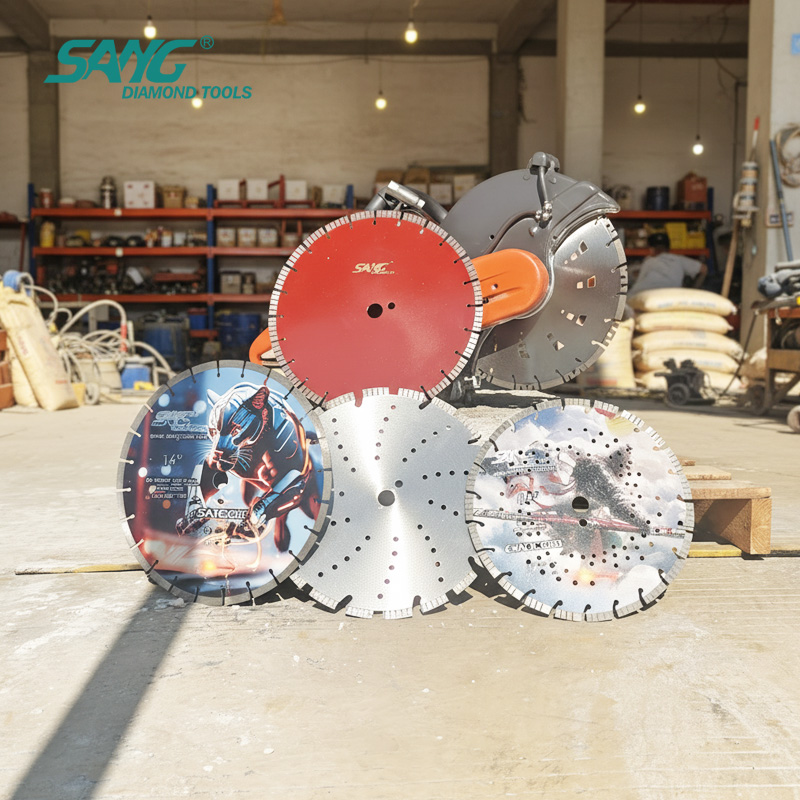
Contractors selected the SANG Laser Welded 300–600mm Arix Segment Diamond Saw Blade for Cutting Reinforced Concrete as a standard option for common structural cutting tasks.
Key technical advantages (jobsite-relevant)
-
Laser welding improves segment retention and reliability under heavy load and heat—critical for a laser welded diamond saw blade used on demanding schedules.
-
Arix segment design (engineered diamond distribution) helps maintain consistent cutting by exposing new cutting points more evenly—useful when cutting reinforced concrete with frequent steel encounters.
-
300–600mm diameter coverage supports a standardized fleet approach: smaller diameters for precision openings; larger diameters for deeper cuts or longer runs.
3) U.S. Project Use Cases (Representative Mega-Project Scenarios)
Use Case A — Interstate Highway & Bridge Rehabilitation (I‑xx Corridor, USA)
Scope: bridge deck repair, barrier modifications, drainage updates, and phased concrete removal under traffic-control constraints.
Typical cutting tasks:
-
Controlled removal lines in reinforced concrete decks
-
Expansion joint demolition cuts
-
Rebar-heavy sections around patch boundaries
Why SANG 300–600mm Arix blades fit:
-
The Arix segment diamond blade design supported stable cutting behavior across mixed material (concrete + rebar).
-
Laser welded segments helped reduce risk during high-load transitions at steel intersections.
-
Multiple diameters let crews choose the right blade for depth without overloading saws.
Observed operational benefits (contractor feedback style):
-
Fewer interruptions for blade changes during night-shift closure windows
-
Better predictability for daily production planning and consumable staging
-
More consistent cut control for follow-on repair work (patching, dowels, anchoring)
Use Case B — U.S. Airport Runway / Apron Concrete Rehabilitation (Major Hub Airport, USA)
Scope: phased slab replacement and utility access cuts under strict time windows and safety procedures.
Typical cutting tasks: long straight cuts on reinforced slabs with strict depth and alignment requirements.
Why this blade worked well:
-
Laser welded construction supported durability during extended, high-volume cutting operations.
-
Stable cutting performance helped crews hold straight lines and consistent depth, supporting QA/QC.
Where 300–600mm range mattered:
-
300–450mm blades for localized repairs and access cuts
-
500–600mm blades for deeper slab profiles or structural zones (depending on equipment capacity)
Use Case C — Large U.S. Data Center / Industrial Plant Expansion (Midwest/South, USA)
Scope: new utility trenches, slab modifications, and equipment foundation adjustments—often with high-strength concrete and embedded steel.
Typical cutting tasks: precision openings, trenching lines, and controlled demolition in reinforced areas.
How SANG blades supported the workflow:
-
The reinforced concrete cutting blade profile delivered reliable penetration when encountering embedded steel.
-
Standardizing blade sizes helped procurement keep fewer SKUs while supporting multiple saw setups across the site.
4) Innovation: From “Blade Choice” to a Measurable Cutting System
In large U.S. projects, high-performing contractors increasingly treat blades as part of a measurable production system. With SANG blades, teams can implement a simple, scalable method:
-
Define standard cut categories: openings, trenching, slab replacement lines, joint removal
-
Assign blade diameter rules (300–600mm) based on target depth and saw power
-
Track consumption by cut category to forecast reorders and reduce emergency procurement
-
Create a site “best-parameter card” (water flow, feed rate guidance, and change-out triggers)
This approach improves cost control and reduces schedule risk—especially on multi-shift or multi-zone job sites.
5) Recommended Best Practices (Contractor-Focused)
To maximize performance and service life:
-
Match blade diameter to machine power and depth (avoid underpowered setups for larger diameters).
-
Ensure adequate water cooling to reduce glazing and thermal stress—critical for any laser welded diamond saw blade doing long runs.
-
Maintain steady feed pressure, particularly when rebar is expected, to avoid sudden impact loads.
-
Standardize blade selection by material conditions (rebar-dense vs hard aggregate zones) to keep predictable cost per cut.
6) Conclusion: Why Contractors Standardize on SANG 300–600mm Arix Blades
Across representative U.S. highway, airport, and industrial construction environments, the SANG Laser Welded 300–600mm Arix Segment Diamond Saw Blade supports enterprise needs for:
-
Stable cutting performance in reinforced concrete
-
Reduced unplanned downtime and fewer blade change events
-
Scalable diameter coverage for varied cutting profiles
-
More predictable consumable planning and procurement
If your team is planning a U.S. infrastructure rehabilitation, airport concrete rehabilitation, or industrial expansion project, SANG can recommend the best diameter selection (300–600mm) based on saw type, cutting depth, and rebar conditions.




 Polski
 English
 فارسی
فارسی français
 русский
 italiano
 español
 português
 العربية
 Indonesia
 românesc
 中文
中文